
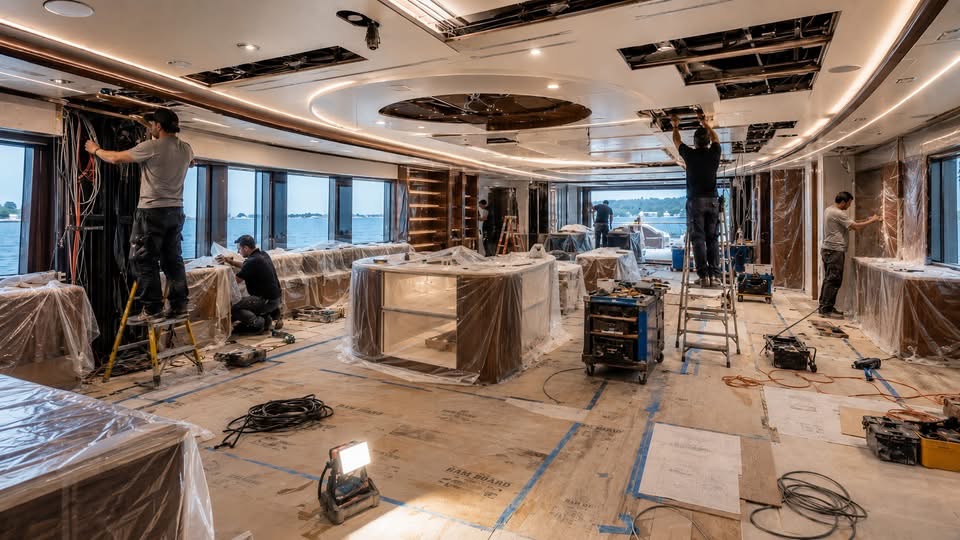
September marks an important transition in the yachting calendar. As the Mediterranean summer season begins to wind down, attention shifts from daily operations to the technical preparation required for the months ahead.
After a season of intensive use, there is now a far clearer picture of the yacht’s actual condition. Recurring technical issues, temporary repairs, scheduled maintenance, crew observations and new owner requirements can be assessed collectively rather than addressed as isolated items.
This is where effective yacht refit planning begins. A successful maintenance or refit period does not start when the yacht enters the shipyard. In many respects, its outcome is determined much earlier — through the quality of the planning, the definition of the work and the decisions made before the first contractor arrives on board.
From Operational Experience to a Defined Scope of Work
A post-season review should go beyond compiling a list of jobs. Recurring failures should be distinguished from isolated incidents, temporary repairs reassessed, and upcoming maintenance requirements reviewed alongside manufacturer recommendations, scheduled services and any relevant surveys, inspections or certification requirements.
At the same time, the owner’s plans for functional, technical or aesthetic upgrades need to be incorporated into the overall strategy. The result should be a clearly defined Scope of Work. This document becomes the foundation of the entire project: the basis for quotations, budget development, yard selection, contractor appointments, procurement and scheduling.
Its accuracy is particularly important when comparing proposals. Two quotations with different totals are not necessarily offering the same scope, technical specification or level of service. Exclusions, assumptions and variations can significantly alter the final cost once work is underway. For this reason, effective cost control starts with defining the project correctly — not simply with selecting the lowest initial quotation.
Why Early Yard Selection Matters
Greece has established a significant position within the Mediterranean yacht maintenance and refit sector, supporting both the domestic fleet and yachts arriving from international cruising programmes. This creates considerable activity during the winter period.
What is considered off-season for yacht operations is often one of the busiest periods for shipyards, specialist contractors and technical suppliers. Early yard selection therefore has a strategic value beyond securing a berth or lifting slot. It provides the opportunity to assess facilities against the actual requirements of the yacht, approach the appropriate contractors, compare proposals and negotiate commercial terms while genuine alternatives remain available.
Planning early may also create better conditions for agreeing prices, resources and project dates before winter demand intensifies. It does not guarantee a lower final cost. It does, however, place the owner in a stronger position: decisions can be based on technical suitability, commercial comparison and project requirements rather than on last-minute availability.
When planning begins too late, the question can quickly change from:
“Which yard is the right choice for this yacht?”
to:
“Which yard can still accommodate us?”
The distinction can have a direct impact on both project quality and cost.
Time Is Part of the Project Contingency
No substantial refit proceeds entirely without change. Inspections may reveal additional work. The owner may introduce a new requirement. Equipment may require a different technical solution than initially anticipated, or a critical component may carry a longer lead time.
The difference between a manageable variation and a disruptive one is often the amount of time available to respond. When planning begins early, changes can be technically assessed, priced, approved and incorporated into the programme with greater control. Under a compressed schedule, even a relatively small change can affect several workstreams. One delayed delivery may hold back a contractor; that contractor may then delay another trade, progressively putting pressure on the yacht’s final delivery date.
Time should therefore be considered part of the project contingency rather than simply a calendar issue. The same principle applies to owner-requested changes. An early start provides the flexibility to review alternatives, source materials and integrate additional work without automatically compromising the entire schedule.
Procurement and Scheduling Must Work Together
Securing a suitable yard is only one part of the preparation. Modern yachts depend on a wide range of specialist systems, equipment, manufacturers and suppliers. Main engines, generators, stabilisers, HVAC, hydraulics, navigation systems, deck equipment and other technical installations may require specific components or authorised specialists.
Interior works introduce their own dependencies, including custom joinery, fabrics, lighting, fittings and bespoke materials with varying production and delivery times. Procurement must therefore be integrated into the project schedule from the beginning. A yacht occupying valuable yard time while waiting for a critical component, material or specialist technician represents both a scheduling and a financial inefficiency.
The objective is not simply to have the yacht in the yard. It is to ensure that the resources required for each stage of the project are available when that stage is scheduled to begin.
Managing Cost Beyond the Initial Quotation
The approved Scope of Work establishes the initial financial framework, but maintaining control throughout the project requires disciplined variation management. Additional works should be evaluated not only by their immediate price but also by their technical necessity, scheduling impact and potential effect on other workstreams.
This is particularly important because budget overruns are not always caused by one major unexpected expense. They can develop progressively through multiple smaller variations, additional labour, changes in specification and works authorised without a clear understanding of their cumulative impact.
Regular comparison between approved budget, committed expenditure and projected final cost gives the owner a much clearer view of the project as it develops. A quotation establishes a starting point. Project control determines where the final figure ends.
Captain and Project Manager: Distinct Responsibilities, One Objective
A yacht refit brings together a wide range of expertise: the owner, Captain, Chief Engineer, crew, shipyard, contractors, suppliers, designers, naval architects and specialist consultants. Effective delivery depends not only on the quality of each individual participant but also on clearly defined responsibilities. The Captain plays a central role. No external party has the same operational understanding of the yacht, its history, the owner’s expectations and the practical requirements of life on board.
The Chief Engineer provides equally critical knowledge of the yacht’s machinery and technical systems. Their contribution is fundamental. Project management, however, is a separate function. The Project Manager is responsible for maintaining the overall view of the refit: Scope of Work, quotations, contractor coordination, procurement, approvals, variations, budget, schedule, dependencies and reporting.
The objective is not to replace the Captain or the Chief Engineer. It is to ensure that each party can perform its respective role while the project itself remains coordinated within an agreed technical, financial and scheduling framework. This distinction becomes increasingly important as the complexity of the refit grows. A shipyard is responsible for its contracted work. Individual contractors are responsible for theirs. The Captain remains responsible for the operational interests of the yacht.
The Project Manager connects those separate responsibilities and maintains visibility across the project as a whole. Selecting the right Project Manager can therefore be as important as selecting the right yard.
Planning Backwards from Operational Readiness
The final day of yard work should not be the same day the yacht is expected to return to normal operations. Commissioning, functional testing, sea trials and final corrective work require adequate time. For this reason, the project schedule should be developed backwards from one critical date:
When must the yacht be fully operational?
That date — rather than simply the planned completion of physical works — should determine the preceding milestones. A yacht that leaves the yard on schedule but without sufficient time to validate the completed work carries unnecessary operational risk into the next season.
September: When the Right Options Are Still Available
September offers something particularly valuable in yacht maintenance and refit planning: choice. There is still time to define the project correctly, select the appropriate yard and contractors, organise procurement and establish a realistic budget and schedule. As planning is delayed, those choices progressively become constrained by availability and deadlines.
A successful refit is therefore not simply defined by the quality of the work completed in the yard. It reflects the quality of the decisions made before the yacht arrives there. The objective remains straightforward: to return the yacht to service technically reliable, operationally ready and within a controlled framework of time and cost.